New options on our PDF, video, and image tools

New options on our PDF, video, and image tools

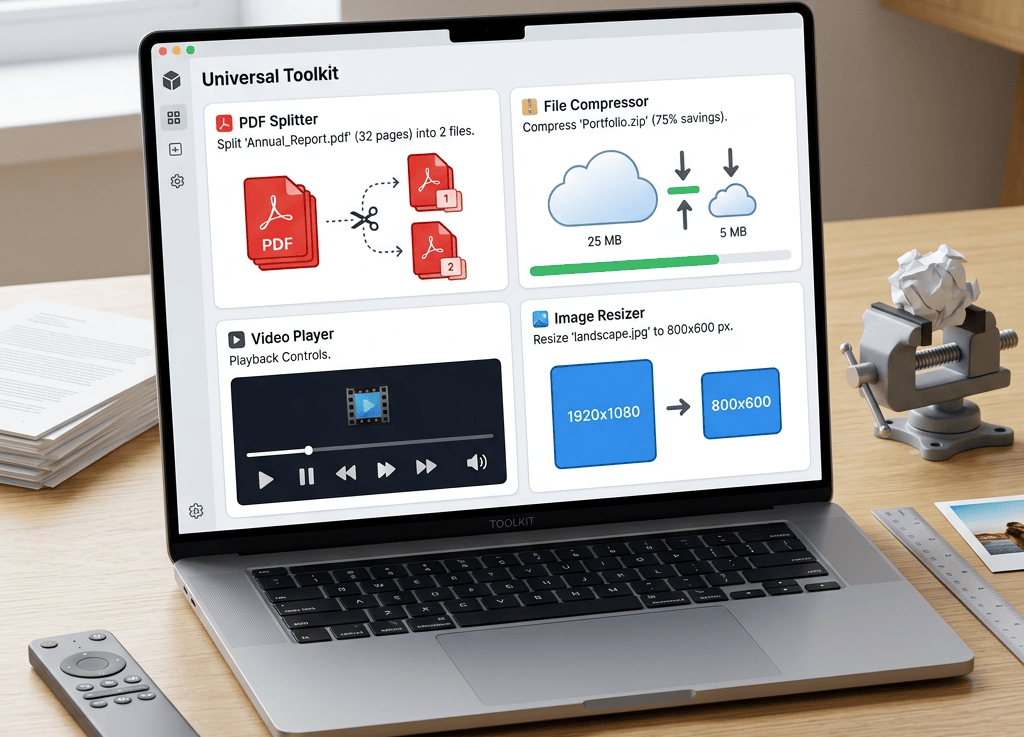
A lot of everyday file jobs are the same: pull a chapter out of a PDF, shrink a scan for email, make a video small enough to upload, or resize a photo for a form. The tools were already there. What’s new is the settings on the page, so you can pick the result you want before you hit convert.

Here’s a practical tour of the options, and when to use which tool.

Split PDF vs Extract Pages

These two look similar. They are not.

  • Split PDF gives you a ZIP of separate files. Each page or range becomes its own PDF.
  • Extract Pages keeps one PDF. The pages you choose stay together in a single download.

Use Split PDF when a portal wants one file per page, when you need odd and even pages as individual documents, or when you want a ZIP of chapters. Use Extract Pages when you want pages 3–7 as one handout, or all the odd pages as a single duplex-style PDF.

Split modes

On Split PDF, choose how the ZIP is built:

  • Custom ranges — each comma-separated group becomes its own file. 2-5,7 means two PDFs: pages 2–5, and page 7.
  • Every page — one PDF per page.
  • Odd pages — pages 1, 3, 5, … each as its own file.
  • Even pages — pages 2, 4, 6, … each as its own file.
  • Fixed page count — groups of 2, 3, 5, or 10 pages (or your own number). The last file may have fewer pages.

Your original upload is unchanged. You download new files.

Extract modes

On Extract Pages, choose:

  • Custom pages — a list or range, still one PDF.
  • Odd pages — every odd page, combined.
  • Even pages — every even page, combined.

That’s the duplex trick: scan a stack, extract odds or evens, and you get one file instead of dozens.

Compress a PDF without guessing

Compress PDF now has a compression level and a colour option:

  • High — smallest file. Fine for email and on-screen reading.
  • Medium — the default. A sensible balance for most documents.
  • Low — sharper images, larger file.
  • Max quality — keep as much detail as possible.

Turn on Grayscale when colour doesn’t matter (forms, contracts, photocopies). That often shrinks the file further.

If you merged several PDFs and the result is still huge, compress the merged file as a second step. Merge itself keeps the pages as they are; it does not re-encode them.

Compress video: codec, speed, and size

Compress Video now lets you choose:

  • H.264 — the compatible default. Plays almost everywhere.
  • H.265 (HEVC) — usually smaller at the same quality. Some older phones and players struggle with it.
  • Encoding speed — Very fast, Medium, or Slow. Slower encoding typically makes a smaller file at the same quality.
  • Resolution — keep the original, or drop to 1080p, 720p, or 480p.
  • Quality (CRF) — lower numbers look better and cost more bytes. Around 23 is a solid starting point.

For WhatsApp, email, or a course upload, try H.264, 720p, and a slightly higher CRF. For archiving a recording you’ll watch on a modern device, H.265 and a slower preset are worth the extra wait.

Resize images without stretching them

Resize Image now has quick sizes (1920×1080, 1280×720, 800×600, and “640 wide” / “480 tall”) plus a lock aspect ratio switch.

Leave the lock on, type one dimension, and the other follows so faces and logos don’t squash. Unlock it only when you truly want a different shape.

Rotate selected PDF pages

Rotate PDF still turns pages 90°, 180°, or 270°. You can now target:

  • All pages
  • Odd pages
  • Even pages
  • A custom range such as 1-3,5,7-9

That’s useful for mixed scans: landscape tables on even pages, portrait text on odd pages.

Flatten, merge, and the rest of the PDF toolbox

Flatten PDF turns forms and annotations into a static document. If the file is password-protected, you can enter the source password on the page. Optional compression is there if you want a smaller flattened file at the same time.

Merge PDF still joins files in list order. After a merge, send the result through Compress PDF if you need a smaller download.

Protect, unlock, crop, organise, remove pages, and extract images are on the same PDF tools list. Each page now spells out what that tool does, so you spend less time guessing between similar names.

A short checklist

  1. Need separate files in a ZIP? Split PDF.
  2. Need those pages in one PDF? Extract Pages.
  3. Need a smaller PDF? Compress PDF (try Medium, then High if it’s still large).
  4. Need a smaller video? Compress Video (H.264 + 720p is a safe first try).
  5. Need a photo to fit a box? Resize Image with aspect lock on.

All of these run in the browser. Upload, pick the options, convert, download. No desktop suite required.
More room to convert — bigger files, more minutes, and real priority for subscribers

More room to convert — bigger files, more minutes, and real priority for subscribers

We’ve upgraded our paid plans, with no change to prices: the upper tiers now accept larger files, Basic gets a more generous monthly allowance, and priority on paid plans now directly affects how quickly your conversions are picked up when the service is busy.

What’s new

  • Larger uploads on Pro and Ultra — more headroom for big videos, archives, presentations, and document packs, so you don’t have to split or compress files before converting
  • More monthly minutes on Basic — extra capacity for regular use, with fewer mid-month surprises
  • Genuine conversion priority — when demand is high, paid conversions move ahead of free ones, and higher tiers move ahead of lower ones
  • Same prices — Basic, Pro, and Ultra cost exactly what they did before

Exact limits can evolve over time, so the pricing page is always the source of truth for current numbers.

How priority works

When lots of people are converting at the same time, jobs are picked up in plan order:

PlanPriorityBest for
UltraHighestHeavy or batch-heavy work, largest files
ProHigherRegular work with larger files
BasicHighEveryday conversions, ad-free
FreeStandardOccasional use

During quiet periods everyone should still feel fast — the difference shows most at peak times, which is exactly when it matters.

What hasn’t changed

  • Your price — no increases on any plan
  • The free plan — still here, still capable for everyday files
  • Credit packs — still available if you’d rather not subscribe
  • Ad-free experience — all paid plans stay ad-free

Already subscribed?

You don’t need to do anything. The new limits and priority apply to your account automatically — no re-purchase, no plan switch, no settings to change.

If you’re deciding whether to subscribe: more room for real-world files, more monthly capacity where it was needed most, and a front-of-queue spot when things get busy. See Pricing for current details, or manage your plan anytime from your account.

Questions or feedback? Get in touch through our contact page.

Convert PDF to Markdown or JSON Online — With OCR for Scanned Documents

Convert PDF to Markdown or JSON Online — With OCR for Scanned Documents

PDFs are made for sharing, not reuse. Copy-pasting from them mangles headings, breaks tables, and loses lists, as anyone who has tried to move a PDF into a wiki, a repo, or an AI tool knows.

So we’ve added two new conversions to FreeFileConvert: PDF to Markdown and PDF to JSON. Both use layout-aware parsing that understands your document’s structure (headings, paragraphs, tables, lists) rather than scraping raw text off the page.

Markdown gives you clean, editable text for any editor, GitHub, or note app. JSON gives you the same content as machine-readable data, with the layout preserved. And if your PDF is a scan rather than a digital file, an OCR toggle reads text straight from the images, with support for English, Spanish, French, German, Chinese, Arabic, and more.

Digital PDF or scan?

The test is simple: can you select text in your PDF viewer?

If yes, it’s a digital document made from Word, Google Docs, LaTeX, or an export. Leave OCR off (the default). The full document is processed with no page cap, and it’s fast.

If not, your PDF is pictures of pages, like a scanned invoice or a photographed contract. Open Fine-tune and switch on Scan or photograph (OCR). Since OCR is slower, only the first 10 pages are processed, so split longer scans into chunks. Setting the document language noticeably improves accuracy for non-English scans.

How to convert

Go to freefileconvert.com, upload your PDF, and pick MD or JSON as the output format. Open Fine-tune if you need OCR or a language setting, then convert and download. Nothing to install; it runs in your browser.

Markdown or JSON?

Pick Markdown when a human will read or edit the result: documentation, blog drafts, notes, READMEs, wiki pages.

Pick JSON when a machine will consume it: automation, content migration, search indexing, or anywhere downstream tools need to know what’s a heading, a table, or body text.

Built for LLMs and AI workflows

Language models work far better with structured text than raw PDFs. Paste converted Markdown into ChatGPT, Claude, or Gemini, and the model sees real headings and tables instead of jumbled extracted text, so answers get noticeably sharper. The clean output also uses fewer tokens, leaving more room in the context window.

For developers, Markdown’s heading structure gives RAG pipelines natural chunk boundaries, so retrieval returns coherent sections rather than arbitrary fragments. Converted specs and API docs can live in your repo where tools like Cursor and Copilot pick them up as context. The JSON output suits agents extracting fields from invoices, contracts, or reports, since the structure arrives as data rather than free text.

Combine this with OCR, and even a photographed contract becomes LLM-ready text in one step.

Tips for best results

Keep OCR off for born-digital PDFs, since it’s faster and more accurate. Reach for it only when text isn’t selectable, and set the language for non-English scans. Split long scans into chunks of 10 pages or fewer. Very complex layouts may need a quick cleanup afterwards, which is still far faster than retyping.

Unit Converter

Unit Converter

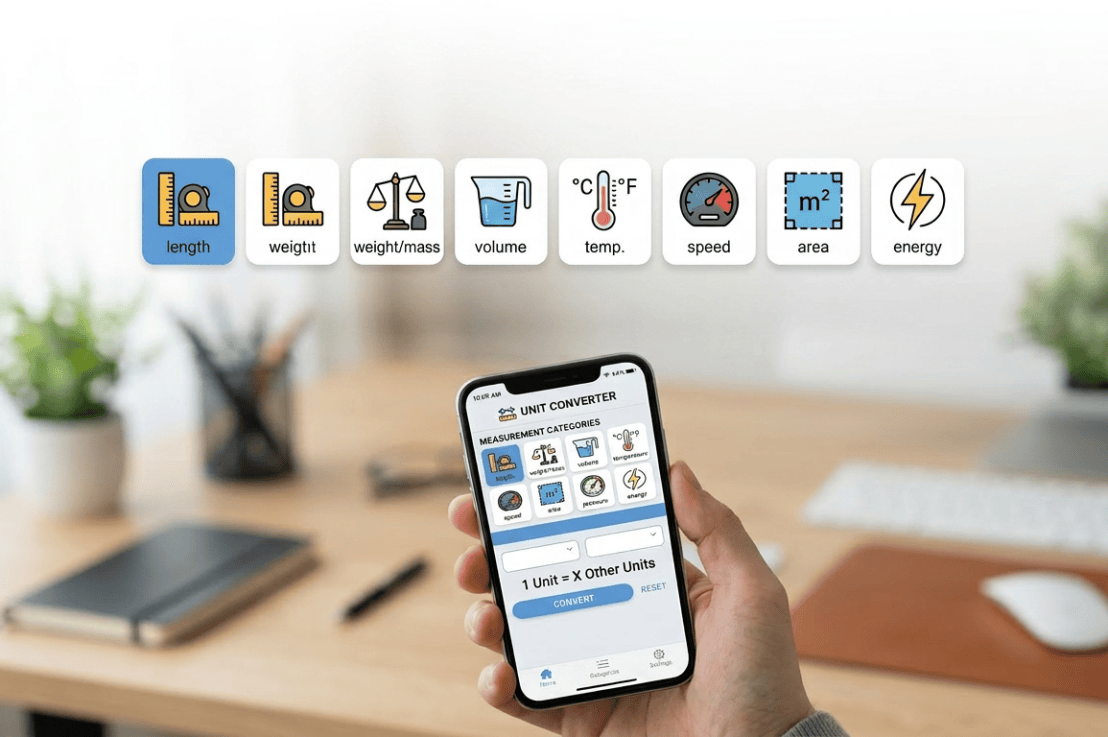
Need to switch between metric and imperial? Converting pounds to kilograms for a recipe, feet to meters for a project, or Celsius to Fahrenheit for travel? FreeFileConvert now offers an online unit converter alongside our file conversion tools.

Convert units in seconds

Open the unit converter, pick a category, enter a value, and the result updates instantly. Swap units with one click, or browse popular conversions like centimetres to inches, pounds to kilograms, and feet to meters.

Each conversion page includes:

  • Clear formulas using standard unit symbols (m, ft, kg, °C, and more)
  • Worked examples so the math is easy to follow
  • Reference tables for quick lookups from 1 to 20 (or a sensible range for temperature)

10 categories, one place

The converter covers everyday and technical needs:

CategoryExamples
Lengthmm, cm, m, in, ft, miles
Weight / massg, kg, oz, lb
Temperature°C, °F, K
EnergyJ, cal, kWh
Aream², ft², acres, hectares
FrequencyHz, kHz, MHz, rpm
PowerW, kW, hp
Electric currentA, mA, µA
ChargeC, mAh, Ah
VoltageV, mV, kV

Whether you’re cooking, studying, travelling, or working on a technical project, the right units are a few clicks away.

Helpful pages, not just a calculator

Every conversion pair gets its own page (for example, feet to meters or lbs to kilograms). Each page explains what the units mean, how the conversion works, and includes a table of common values. Handy if you’re learning the relationship between systems or need a quick reference without opening a spreadsheet.

Part of the FreeFileConvert toolkit

The unit converter sits next to our time zone converter and file tools (PDF, video, image, and more). Same site, same simplicity: open the page, get the answer.

Get started: visit freefileconvert.com and choose Unit Converter from the Tools menu.